


At the SBC Summit Canada in Toronto back in May, Dale Nally, Alberta’s Minister of Service Alberta and Red Tape Reduction, gave a number of reasons why he thought the province’s open, regulated online gambling market would be a success.
Those words, as covered in GNC’s May 27 newsletter, are proving prescient now that the Alberta iGaming Corporation (AiGC) has released the numbers from the market’s first three months of operation.
“We’re hard working, we’re industrial and entrepreneurial,” Nally said of Albertans. “Our workforce is younger than workforces in the rest of Canada because of our oil and gas industry. It attracts younger people from across the country to come to Alberta. So, our workforce is younger, we have lower taxes, and we have higher wages than the rest of the country. That means more disposable income. And if you didn’t already know this, Albertans like to gamble responsibly, but we like to gamble.”
Just how successful has Alberta’s open sector been since it launched on July 13? Gaming News Canada compared that province’s first three months with the first months after Ontario launched its regulated market on April 4, 2022. Alberta is not only holding its own, in some areas it has already surpassed what the Ontario sector accomplished in its first three months.
Of course, such comparisons are not perfect and there are a couple of things to remember when digesting the numbers:
Ontario’s population of 16.2 million is more than three times that of Alberta’s (5 million), which makes Alberta’s numbers even stronger.
Ontario’s numbers benefited from it launching at the beginning of a month, rather than part-way through a month as happened in Alberta. Again, advantage Alberta on that one.
The climate and general acceptance of online gambling is much different in 2026 than in 2022, in part because consumers are more aware of online gambling since Ontario launched.
That said, the Ontario and Alberta markets are strikingly similar in terms of what is offered and the regulatory rules. In fact, the Alberta sector is based on the Ontario model.
But, let’s get to the numbers.
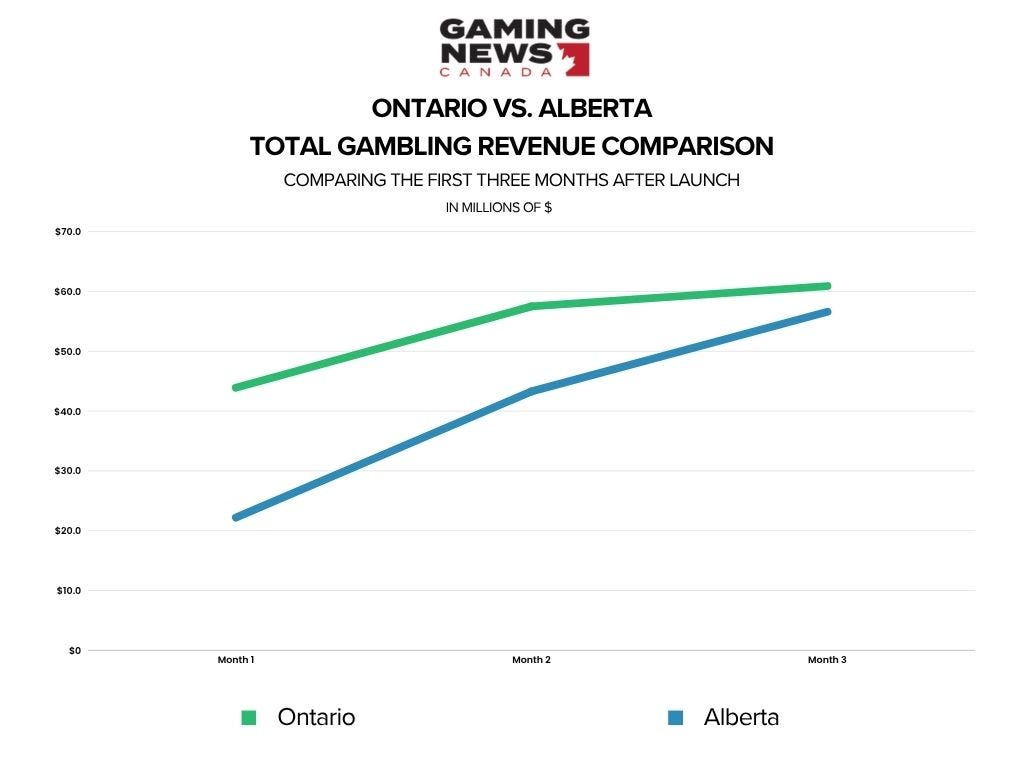
Total online gambling revenue in Alberta from July 13 through Sept. 30 grew from $22 million in July to $43.3 million in August (remember this was the first full month recorded) to $56.6 million in September for a total of $122.1 million in online gross gambling revenue.
In Ontario, revenue went from $43.9 million in April of 2022, to $57.5 million in May and $60.9 million in June for a total of $162.3 million in online gross gaming revenue.
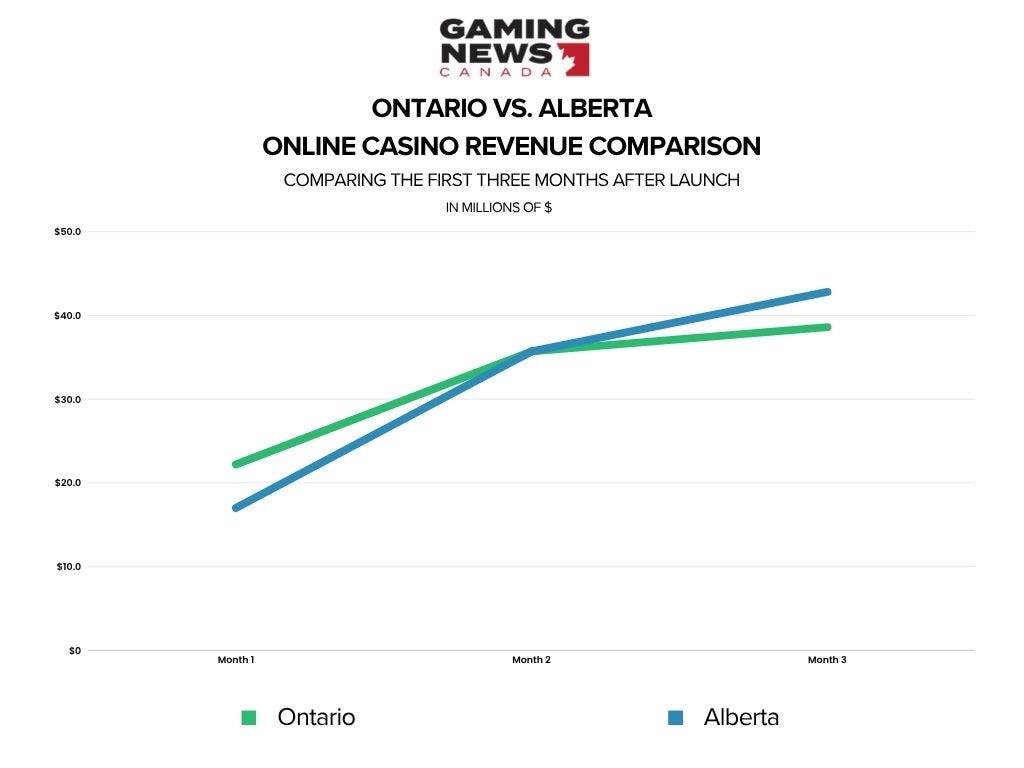
What’s striking are the online casino numbers. Alberta has already surpassed where Ontario was in its third month - with one-third of the population.
Alberta online casinos went from revenue of $17 million in July to $35.7 million in August and $42.8 million in September.
Ontario’s online casinos had revenue of $22.2 million, $35.7 million and $37.6 million in each of its first three months, respectively.
Also, unlike Ontario, Alberta carves out a separate revenue number for live casinos. If the live casino figures are added to the other casino numbers, Alberta actually had total online casino revenue of $18 million, $38.1 million and $45.6 million in its first three months, respectively.
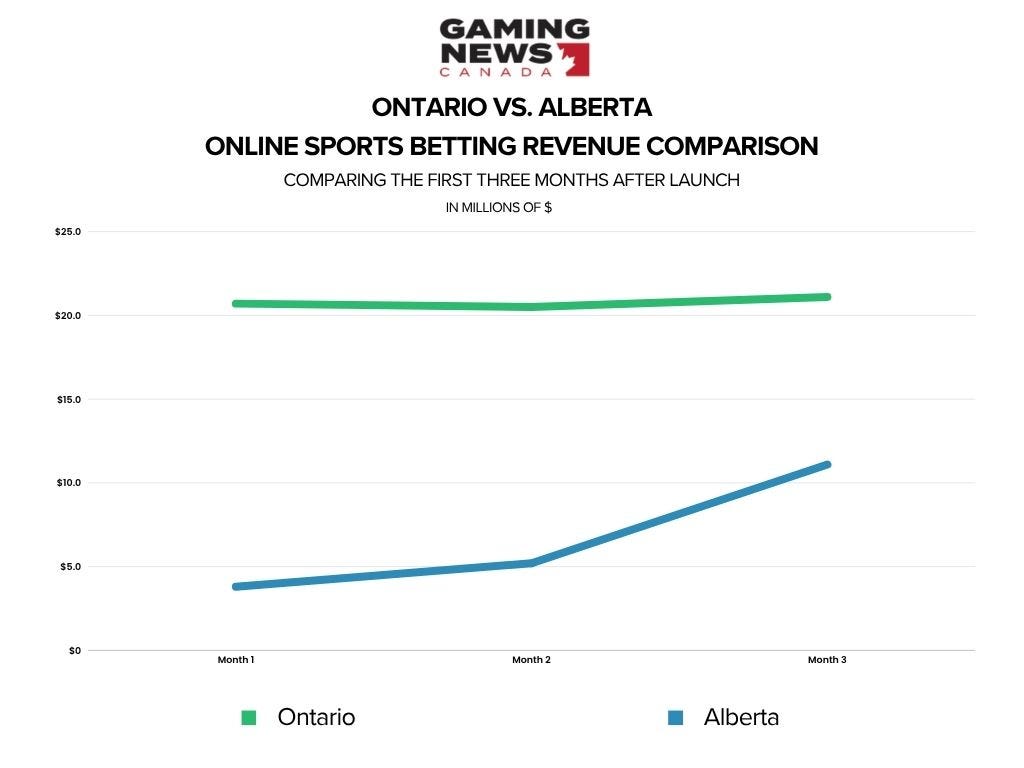
Meanwhile, sports betting figures were much stronger in Ontario’s first three months compared to the first three months in Alberta, but there are plausible reasons for the difference. April, May and June are much more attractive sports betting months than July, August and September.
That plays out in the handle numbers. In Ontario, sports betting handle in the first three months was $348 million, $420 million and $348 million, compared with $60.9 million, $112.2 million and $153.7 million in Alberta.
That’s also reflected in the sports betting revenue figures. Ontario had revenue of $20.7 million, $20.5 million and $21.1 million in its first three months. Alberta’s online sports betting revenue was $3.8 million, $5.2 million and $11.10 million.
As for month-to-month growth, Alberta is outpacing Ontario in that department, too. If you throw out the growth change from month one to month two, because Alberta launched in the middle of July, and just look at the revenue growth from month two to three, here are the numbers:
Ontario total revenue grew 6 per cent.
Alberta total revenue grew 30.7 per cent.
Online casino revenue grew 8.1 per cent in Ontario.
Online casino revenue grew 20 per cent in Alberta.
Ontario’s online sports betting revenue grew 3 per cent.
Alberta’s online sports betting revenue grew 113 per cent.
Finally, market share. Alberta’s online casino revenue commanded a much larger share of the market from the start. It was 76.54 per cent in July, 82.3 per cent in August and 75.6 per cent in September. In Ontario’s first three months, online casinos made up 50 per cent, 62 per cent and 63 per cent of the total revenue. Though, today, online casinos command above 75 per cent of the revenue in Ontario.
Conversely, that means in the first three months since launch, Ontario’s sports betting revenue had a much larger piece of the pie (47 per cent, 36 per cent, 35 per cent) compared to Alberta (17.3 per cent, 12.1 per cent and 19.5 per cent).
Other items of interest in the AiGC market performance report include:
Albertans are placing more than $1 billion in bets each month.
The number of active accounts grew from over 225,000 in July to nearly 400,000 by the end of September.
The number of operators grew from 16 in July to 20 in August and 24 in September. There are 51 regulated operators in the market today and between 60 and 65 are expected by the end of 2026.
Alberta is also doing a better job than Ontario on focusing on responsible gambling and transparency first and foremost.
Unlike Ontario, Alberta had a centralized self-exclusion system in place on launch day.
Also, an AiGC press release announcing the numbers starts with this: “Responsible gambling was built into Alberta’s regulated iGaming market from day one. Every player is verified, and every site must provide tools to manage play.”
The release also clearly spells out how much of the government’s take is being directed toward responsible and problem gambling programs. One per cent of revenue is directed toward “social responsibility programs… in mental health and addiction, as well as research,” while a further two per cent goes to First Nations.
Alberta could further beat Ontario in the transparency game if it released specific operator revenue figures — as is commonly done in many U.S. states — but that’s probably wishful thinking.
Also, the AiGC is reporting an early win in converting Albertans from unregulated sites to the legal market, which was a prime reason for regulating. Though, there’s no numbers or estimates for how many Albertans have made the switch.
“Early results indicate that Albertans value the strong oversight and greater accountability offered by a regulated market,” said AiGC CEO Dan Keene in the release. “We hope to continue educating Albertans about the risks associated with illegal offshore sites and move them onto regulated platforms where they have rights and recourse when iGaming.”
All of this means Alberta is off to an exceptionally strong start, even in comparison to the gambling behemoth that is Ontario.

Is your iGaming platform truly driving your digital growth? Choose a provider that aligns directly to your ambitions.
Click here to find out what other global operators have to say about the unparalleled partnership of Bede Gaming.
Nova Scotia lobbyists hired to push for open, regulated market
The Investigative Journalism Foundation has reported that the Canadian Online Gaming Association (COGA) has registered two lobbyists to try to convince Nova Scotia politicians to launch an open, regulated online gambling market similar to the ones in Alberta and Ontario.
Nova Scotia currently only offers an online gambling platform operated by the Atlantic Lottery.
The article, written by Carly Penrose, said that the COGA has hired former federal Conservative staffers Carly Sieb and Luis Lopez to lobby provincial lawmakers. Sieb and Lopez work for public relations and lobbying firm Endgame Strategies, one of three firms COGA hired to lobby for an open market in Ontario.
Penrose wrote that the “COGA wants Nova Scotia ‘to support a regulated iGaming market, including presenting recommended guiding principles for a future regulatory framework’.”
The IJF article follows reporting last week that the Susan Holt government in New Brunswick is “exploring its options” regarding regulated gambling.
The latest on the angst around advertising
From the Dept. of Sure Things in Life, these days you can add angst about gambling advertising to death and taxes.
There are moving parts a plenty, especially as it relates to government goings-on. Tomorrow (Thursday) morning, the federal Standing Committee on Canadian Heritage is scheduled to discuss Bill S-211. Senator Marty Deacon, who introduced the bill to create a national framework on sports betting advertising act in the Senate back in May 2025, is expected to speak. So is Waterloo (ON) MP Bardish Chagger.
If/when the bill is approved at committee, it would be presented for a third and final reading in the House of Commons.
The Canadian Centre on Substance Use and Addiction, and Greo Evidence Insights, have delivered a joint submission to the standing committee in support of the bill with the following recommendations:
Advance Bill S-211;
Recognize that sports betting advertising operates within a broader online gambling ecosystem, including online casino products, and consider measures to address all online gambling advertising and promotion; and
Ensure that the framework places public health at its centre, with the protection of children and youth as a central priority, alongside young adults, people in recovery, people affected by others’ gambling and other populations at elevated risk.
Alberta Premier Danielle Smith, appearing on a radio show last week, was asked by a caller about the wave of advertising since the province’s regulated gambling market launched in mid-July. Smith said she’ll be speaking with Service Alberta Minister Dale Nally and is also watching what happens with Bill S-211. We’ll point out that Nally, speaking at the Global Gaming Expo last month, said the province doesn’t support the bill.
“(It’s) another example of federal overreach on a provincial jurisdiction,” Nally said during his appearance on a panel.
Smith’s comments came days after CBC collaborated with the University of Bristol to examine “the numbers of logos and gambling messages” over seven Stanley Cup playoff games involving Canadian teams. According to the results of the study, ads or logos appeared 2-3 times every minute during the broadcasts. The advertising included logos in the arenas, on jerseys and helmets, and during commercial breaks.
Raffaelo Rossi, who led the university’s study, said Canada trails other countries when it comes to placing restrictions on gambling advertising.
“Multiple countries . . . have introduced quite strict regulations and restrictions on gambling marketing in sports,” Rossi told the CBC. “So, for example, in Belgium and Italy and Spain, there’s almost entire bans on sponsorship during sports.”
Earlier this year, the Australian government also imposed new rules around advertising, including a complete ban on gambling advertising during live sports broadcasts.
We will mention, once again, that the advertising issue is far from being black and white. There are many stakeholders (government, regulators, operators, other industry participants, media companies, sports leagues, teams and organizations) who we suggest need to have a seat at the table. Together, they need to find consensus on a solution that recognizes the rights of licensed operators to run successful enterprises in a regulated environment while also finding ways to have protections in place for Canadians who engage in all types of gambling.
Atlantic Lottery profits take a hit in 2025-26
Amidst the various rumblings about the road to regulated gambling potentially being extended to Atlantic Canada, the region’s lottery and gaming organization released its 2025-26 annual report last week.
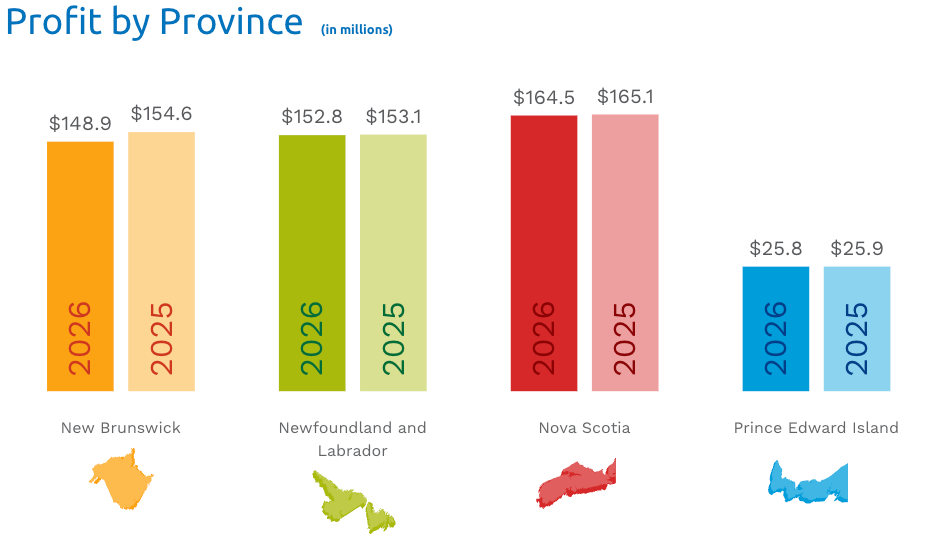
For the folks who believe gambling’s arrival coincided with the creation of the World Wide Web, Atlantic Lottery turned 50 in 2026. For its latest fiscal year, the corp delivered $492 million in profit across the four provinces (Nova Scotia, New Brunswick, Prince Edward Island, and Newfoundland and Labrador). That profit fell just short of the organization’s $502.4 million target and a decrease of $6.6 million from 2024-25.
The revenue dips in draw games, instant games and video lottery are the result, according to Atlantic Lottery, of challenges “compounded by the rapid growth of illegal online gambling operators.”
“Atlantic Lottery is facing a level of disruption that is unprecedented in our 50-year history and the effect on our financial performance last year was clear,” said CEO Dallas McCready in a news release. “The growth of illegal online gambling has fundamentally changed the competitive landscape. These operators are drawing significant gaming dollars out of Atlantic Canada, contribute nothing to provincial revenues in our region, and are not subject to the same healthy play and consumer protection requirements that govern Atlantic Lottery.
“We are taking decisive action to compete effectively while continuing to protect players and maximize returns for the benefit of Atlantic Canadians.”
The corp’s online betting and gaming activity saw a slight year-over-year increase (35 per cent, compared to 34 per cent the previous fiscal year). According to the news release, “approximately $250 million is estimated to leave the regional economy each year through illegal operators.”
From the online business:
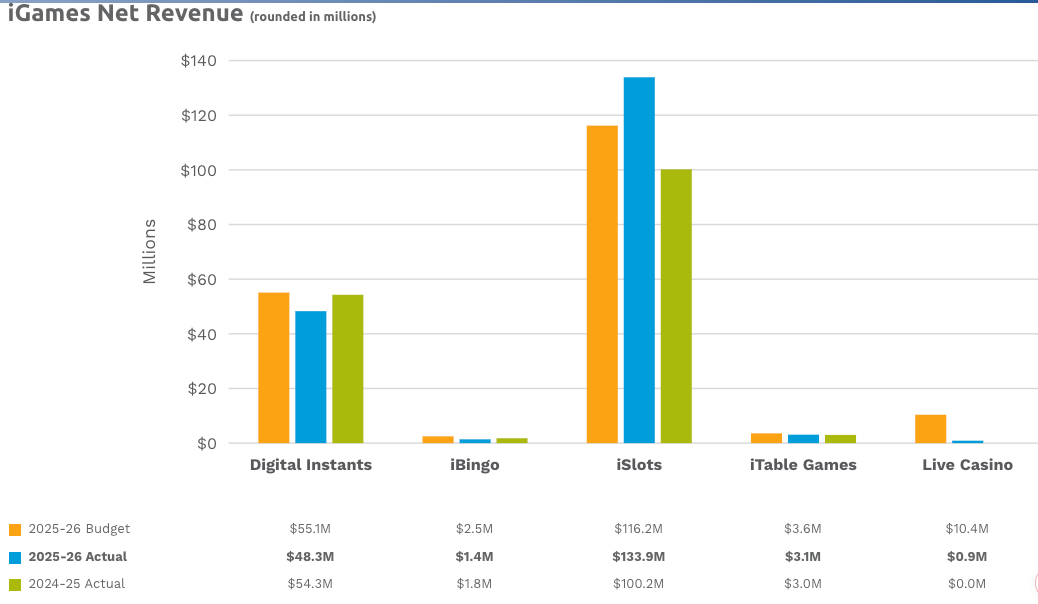
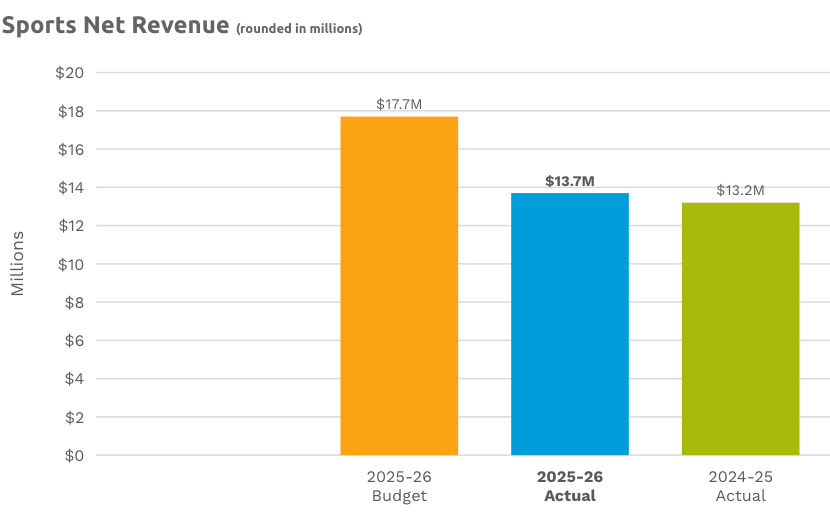
Of interest to standardbred racing aficionados, increased betting activity at Charlottetown Driving Park and Summerside Raceway meant a $40,000 increase in racing revenue from the previous fiscal year. Simulcast revenue, however, dropped 18.4 per cent, the result of reduced wagering volumes in traditional simulcast and HPIbet channels. Poor weather also meant fewer race dates in key simulcast markets.
BetMGM partnerships leader on the NFL, Detroit and the “Canadian triangle”
In a previous life, when the Gordie Howe Bridge hadn’t been conceived, and the Detroit Red Wings were putting competitive teams on the ice (sorry Motor City sports lovers. . . ), Molly Wurdack-Folt had a front-row seat to the cross-border fandom between Canadians and Americans.
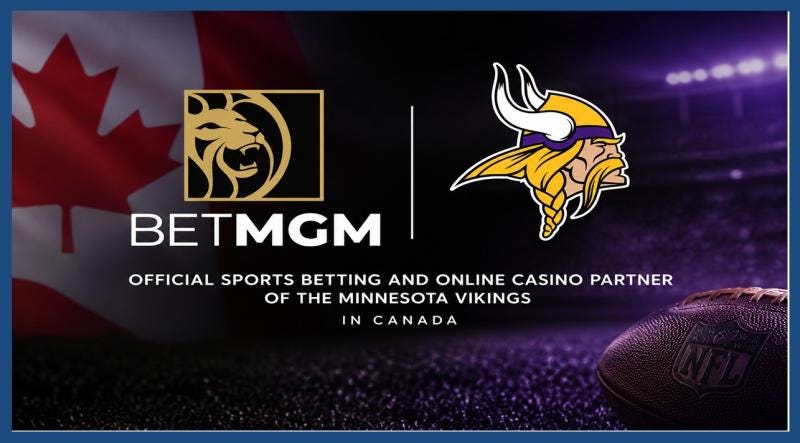
So, there’s very little surprise that in her current role as senior partnerships director with BetMGM that Wurdack-Folt is. . . er. . . parlaying her past into making partnership deals of the NFL sort. In recent weeks, BetMGM has been named the official sports betting and online casino partner of the Minnesota Vikings in Canada and renewed its partnership with the NFL in Canada as an official sports betting partner.
“The NFL is a beast in all the great ways,” Wurdack-Folt, BetMGM’s senior director of partnerships, said matter-of-factly during an interview of the virtual kind earlier in October. “The NFL season is one of the most important times of the year and (the Vikings and league partnerships) give us the ability to leverage IP across all of Canada.
“That shield draws a lot of value for us.”
Back to the Detroit connection. For 14 years, Wurdack-Folt moved up the ladder on the Motor City sports scene, first in ticket service and retention with Olympia Entertainment, then in ticketing and marketing with the Red Wings before moving into marketing and VP, marketing activation roles with Illitch Sports & Entertainment before leaving in December 2022 to join BetMGM.
“We always used to talk about the Canadian triangle. . . Windsor, Sarnia and London,” said Wurdack-Folt, bringing back memories for your crow’s feet-marked correspondent of his younger years watching Tigers and Blue Jays games while sipping on beer and mowing down chicken wings at Joe Kool’s in London. “I know how much Detroit sports resonate there.”
BetMGM is exploiting an opportunity created by the NFL “a couple of years back”, according to Wurdack-Folt, for teams to extend their marketing territory beyond a 125-kilometre) radius. The partnerships with the league and teams allow BetMGM to introduce products such as Big Kick LuckyTap – a football-themed online game – into Ontario and Alberta and extend the relationship beyond sports betting.
“We have a nice hierarchical approach,” she said. “We have the league IP for wide-reaching scope and use that across all our marketing channels. We also have the local connection and that allows us to say, ‘how can we localize efforts and meet players and potential players where they’re at.”
She continued: “The teams have been tremendous partners in embracing online casino. They see the value, and it’s a unique point of differentiation we can offer to their fans.”
The Vikings partnership especially makes sense for both parties. Minnesota has yet to legalize online sports betting and iGaming, so the Canadian partnership is a marketing opportunity for the Vikes, who have long been known to have strong ties to football fans in Manitoba and northern Ontario. And, for Wurdack-Folt et al at BetMGM, they receive the rights to Vikings team and player marks for its betting, casino and marketing activities in both Ontario and Alberta.
People on the Move
Ian Freeman is named Chief Operating Officer at Strive Gaming.
Nicole Mastrocola has a new gig at Great Canadian Entertainment as Chief Compliance Officer.
Ali (Ako) Muhanned is named CEO at BC Game.
Ally McIvor joins Booming Games as Chief of Sales.
Aloplay appoints Styliana Kalogreadou as Chief Business Development Officer.
Will Tyrrell is named Managing Director – UK and Alex Beecham as Managing Director – International at Checkd Group.
Charles Jeffers is appointed interim Executive Director at the National Council on Problem Gambling in the U.S.
Boyd Gaming promotes Rick Goldstein to Senior Vice President of Operations of the Suncoast, Aliante and Cannery hotel/casinos.
Aaron Aita is appointed Vice President, Investor Relations & Finance at PENN Entertainment.
Griffin Tendler is named Vice President of Restaurant & Retail Marketing at Hard Rock International.
Entain appoints Paul Tinsley as Global Head of Numbers, Virtual & Esports.
Lindsay St. Lawrence is leaving IGT and her position as VP, Product Solutions.
PlayVS names Alyvia Moss as Head of Engineering.
Carla Formosa departs Playnetic and her Head of Marketing role.
Betty UK appoints Desislava Kocheva as Head of People and Culture.
Liz Freeman, ex of The Weather Company, Betting Hero and FanDuel, joins Rush Street Interactive as Senior Director of Research.
Charlene Nielson has a new title at BCLC: Director, Casino.
JP Valenzuela departs Aristocrat and his role as Global Director of Technical Compliance.
Playtech promotes Irene Markitani to Director of Sustainability.
Johan Rikner says goodbye to LeoVegas Group and his position as Director of Performance, Nordics.
Former FanDueler Ashley Cahill and and ex-EPIC Global Solutions senior veep Teresa Fiora have launched Fiore Cahill Advisory.
Andrew Roach has a new gig at iGaming Ontario as Senior Manager, Operator Relations. Jess Ludgate, ex of the Teaching Council of Aotearoa New Zealand, is named a Privacy Officer.
Meghan Irons joins the Ontario Ministry of Tourism, Culture & Gaming as a Manager to support the Destination Niagara project.
Amy Elliott, ex of NorthStar Gaming, joins PURE Casino Entertainment as a Manager, iGaming Accounting.
Gaming industry journalist Craig Corbeels is a free agent following his departure from ClickOut Media.
Simon de Boer is promoted to Vice President at CFL HQ.
After eight years, including the past 17 months as Senior Director, Business Strategy & Program Management, Connor King bids adieu to MLSE.
Classified (Jobs) Information
On the Home Front
There’s a Toronto-based opportunity for a Casino Product and Commercial Lead.
Fanatics has an opening in Toronto for a Senior Campaign Operations Manager – Casino.
OLG is on a seek-and-employ mission for a Senior Manager, AI Strategy & Program Lead.
The Saskatchewan Liquor and Gaming Authority is on the lookout for a Regulatory Analyst.
In North York, ON., Boyd Gaming is hiring a Compliance Analyst.
Pavilion Payments is seeking people with experience in gaming and fintech.
PURE Canadian Gaming requires a CRM & Marketing Coordinator.
In Vancouver, Electronic Arts is searching for a Senior Director, Creative – EA Sports FC.
The Toronto Tempo have an opening for a Data Engineer, Basketball Strategy.
Sports data company Stathletes has a part-time position available for a Live Auditor.
The Globe and Mail is hiring a Deputy Opinion Editor.
South of the Border
In the U.S. of A., EPIC Global Solutions is hiring a Vice President, Player Protection and Commercial Partnerships – North America.
In Vegas, MGM Resorts International is seeking a Director of Slot Strategy – Bellagio.
BetMGM and LeoVegas Group has several positions available across its Performance Analytics teams.
Hard Rock Digital is in the market for a Trading Intelligence Analyst – Trading Origination and an Analyst – Gaming Compliance.
DraftKings has a remote opportunity for a Lead Product Designer, Core Journey.
In New York, JPMorganChase is looking for an Influencer & Creator Marketing Lead, Talent Partnerships & Culture, Vice President.
Across the Ponds
Playtech has an opportunity in London for a Head of Internal Controls and Assurance.
Playnet is searching for a Marketing Director.
Wanted at GR8-Tech: a Senior Quantitative Analyst/Sports Betting Mathematician.
Spotlight Sports Group is in the market for a Gaming Content Editor.
LeoVegas Group has an opening in Sliema for a Casino Specialist.
In Valletta, Playtech is seeking a Compliance Manager.
There’s a trifecta of employment opportunities at NetBet.
For Your Perusing Pleasure
The Minister of Canadian Identity said he’d consider expanding the scope of the federal digital safety bill to include gaming platforms.
Geoff Zochodne got in the weeds on what the two-day suspension imposed by the AGCO on PointsBet Canada means for the operator, and the customers.
News from OLG last week that it distributed $34.5 million to 29 communities that host land-based casinos.
Speaking of OLG, it has a new partnership with sports betting integrity and compliance technology company IC360.
There’s a new ad out and about for PlayAlberta:
ICYMI, ESPN’s David Purdum has the deets on the banned Ohio bettor who made threats against Toronto Blue Jays manager John Schneider during last year’s World Series.
There’s a new study on casino and online self-exclusion in Canada.
AGCO senior executive Dave Phillips posted via the LinkedIn about his appearance on a panel regarding the fight against illegal gambling at last week’s International Association of Gaming Regulators conference.
Eilers & Krejcik Gaming has put out its latest Overall and Slot rankings for Alberta and Ontario.
ICYMI, the rebranded Canadian Alliance for Regulated Gaming has a new website.
The U.S. strategy used by Polymarket and Kalshi could come back to bite them beyond America’s borders, reported Sportico’s Dan Bernstein.
Did you hear the story about the journalist who went to Las Vegas and ended up at the library? On a more serious note, good stuff here from Geoff Zochodne on “sports betting’s first-ever textbook”.
The latest edition of Steve Ruddock’s Straight to the Point newsletter is exactly that when it comes to the sports betting industry in the U.S. From his must-read: From the outset, I’ve been cautioning the industry to slow down (and I’m far from the only person): Why are we rushing bills through state legislatures (and exaggerating the impact of moderate tax rates and other burdens)? Why are we rushing launches? Why are we not making any meaningful concessions to the responsible/problem gambling side or going above and beyond and self-regulating?
Speaking of Ruddock, he had as his guest on the STTP podcast Barron’s journalist Nick Devor.
Jake Wosenwasser and Jim Axelrod of CBS News reported on the VIP practices of online sports betting operators, which are coming under fire from U.S. lawmakers.
Speaking of CBS, Brett Logiurato was first to report the network has sold its local election night coverage to DraftKings.
There’s a new study out of the University of Colorado Boulder on the link between gambling advertising and betting activity.
The NBA has joined MLB and the NHL on the prediction markets partnership bandwagon.
Meanwhile, Dominick Mastrangelo wrote for The Hill that online sports betting may open the door to a new chapter of the longstanding bunfight between the NFL and the president of the U.S. of A.
The aforementioned Purdum also had reporting on the two former U.S. college basketball players and an ex-sportsbook employee facing charges from an alleged match-fixing scheme.
Our fellow gambling chronicler Matt Rybaltowski flagged this Salt Lake City Tribune piece on some controversy around cameras being installed inside Utah State University’s basketball arena for sports betting-related purposes.
An Australian sports betting operator is facing a lot of criticism for the suicide of a young man.
Dan Waugh continues to take umbrage with the UK Gambling Commission’s (mis)use of data.
Hippos ATG head honcho Antti Koivula did the Q and A thing with iGaming Expert about Finland’s incoming regulated gambling market.
The latest target of Kalshi’s legal beagles is the Attorney General of Louisiana.
Given all the furor around the shutting down of Brazil’s regulated gambling market, we figured it only right to deliver the results of the latest presidential election. Declan Hill credits Lulu’s sports betting ban for his re-election.
Speaking of Brazil, Evolution is shutting down its operations there.
A UK gentleman has been sentenced to two years in jail for using money from COVID-19 loans to support his gambling habits.
Speaking of the UK, tax hikes to the gambling industry continue to have an impact on sports sponsorships.
WagerWire co-founder Travis Geiger was Jeff Edelstein’s guest on the Business of Betting podcast.
The Council on Foreign Relations has some thoughts and layers on the “promise and perils of election markets”.
For the sports media followers among our loyal subscribers, the Toronto Sun’s Rob Longley wrote about the angst over access to Maple Leafs games on the screens.
Stay up to date with the news on the Canadian gaming industry by following us on LinkedIn and Twitter.
Please send your news releases and other announcements to steve@gamingnewscanada.ca. Also, if you’re interested in learning about our sponsorship and advertising opportunities in the newsletter and on our podcast, please email Steve McAllister.
