


An investigation by Brendan Kennedy of The Toronto Star that iGaming Ontario quietly deep-sixed a study meant to track problem gambling rates in the province got the attention of many folks across the industry late last week and over the weekend.
As for getting people talking, that’s a whole other story.
Kennedy’s reporting, which was the lead story on the front page of The Sunday Star and was released online last Friday, is a must read. The news outlet’s investigative reporter also appeared on a video to explain the journalism he did here:
And The Star editorial board Monday called for Premier Doug Ford to “explain and account for the iGaming Ontario scandal.”
To summarize the investigation for our readers:
iGO commissioned the study (which was eventually given to the Responsible Gambling Council through a bidding process) months before the launch of the province’s regulated sports betting and igaming market in April 2022. The research would be made public, the agency said and that it would provide, in Kennedy’s words, “a baseline for problem gambling in Ontario while informing how they tailored their responsible gambling program.”
Records obtained by The Star – through freedom of information legislation – showed concern with iGaming executives when researchers reported that problem gambling rates were much higher than expected. A decision was then made to keep the research confidential.
iGO, worried that the findings would get into the public domain, tossed around ideas for damage control including discussion of a “gag order” and, wrote Kennedy “other strategies to minimize the chances the researchers may “bad mouth” iGaming Ontario.
During the process, iGO wanted to change the methodology for the study. Gaming News Canada has learned that iGO had concerns about the methodology and hence, the study didn’t meet the standard required for informed policy development.
The cone of silence that has been pervasive in this industry over our five years of covering it was on full display. Kennedy reported that iGO wouldn’t make anyone available for an interview and didn’t answer a detailed list of questions for his story. Martha Otton, iGO’s executive director when the market launched in 2022, didn’t respond to Kennedy’s request for comment, nor did Shelley White, then the Responsible Gambling Council’s CEO, who has since retired but was appointed to the board of directors at iGO a year ago. Current RGC CEO Sarah McCarthy also declined to be interviewed.
Gaming News Canada reached out to iGO, the RGC, the AGCO and the Minister of Tourism, Culture and Gaming’s office with requests for interviews and/or statements. Emails sent to the Ministry’s communications office Monday and Tuesday went unanswered, while the comms staff at iGO and RGC emailed statements. As of the publishing date this morning, we were awaiting a statement from the AGCO.
From a spokesperson at iGO:
“Ontario’s regulated online gaming market has some of the strictest standards in the country, and we continue to work with our partners to strengthen responsible gaming and protect players across the province.
iGaming Ontario has implemented a variety of structural and programmatic improvements to better support responsible gaming. These include investing nearly $5 million over the last year in responsible gaming initiatives and player supports, including on-campus education and outreach programs as well as the launch of BetGuard, Ontario’s new self-exclusion tool that allows players to opt out of the regulated online gaming market.
We will continue to build on these protections while introducing new tools, programs and partnerships that support player health across Ontario.”
Our question for the RGC focused on two researchers – Iris Balodis and Michael Wohl – being brought in to assist the organization with research after being named the successful bidder and if the council was directly involved in the study. An RGC spokesperson confirmed that and added, “under our contract with iGO, the data and findings are iGO’s property and the decision on how and when to publish rests with them.”
In Ontario, the current Conservative government continues to lower the cone of silence over the leaders of its agencies when it comes to speaking with journalists. As so often is the case the only person willing to be interviewed was Canadian Gaming Association president/CEO Paul Burns.
“What bothers me the most is it looks like we’re hiding and that’s not what the industry is built on,” Burns told us during a phone interview yesterday. “We’re built on transparency and trust.
“One of my biggest concerns is we support public evidence-based research based on trustworthy data. It’s the old adage if you can’t measure this, how do you prevent and reduce it. That’s why we advocate for regulated markets.”
Burns added that the CGA supports independent research but also said research that helps find solutions is best accomplished through collaboration between the industry and the experts collecting and analyzing the data.
“There are a lot of good researchers that the industry works with,” Burns told GNC. “We have a role to coordinate on strategy, which dictates what the research should be and what we should tackle.
“We’ve always supported independent research.”
“Why are we still trying to figure this out?”: Brock University professor.
Back in the early days of this media outlet, including our Thursday afternoon chin wags on Clubhouse, then Twitter Spaces and later LinkedIn Audio, Dr. Michael Naraine was a frequent participant. After Ontario’s regulated market set sail in April 2022, the Brock University professor was a frequent and loud voice in calling for the provincial government to provide funding for research into the potential health effects of gambling.
Since then, Naraine has researched the effectiveness of responsible sports betting PSAs, appeared on panels organized by Greo Evidence Insights and the Alberta Gambling Research Institute, and in July 2025 joined the then newly-created Institute on Sports Wagering and Gaming at San Diego State University. So, when Gaming News Canada reached out to Naraine on Monday for his reaction to The Star’s investigation of the hidden iGaming Ontario study, the professor didn’t hold back.
“Why are we still trying to figure this out?” asked Naraine, referring to the lack of research available in Ontario.
During an interview with your neighbourhood editor-in-chief, Naraine was highly critical of iGaming Ontario’s tendering process and eventual awarding of the research contract to the Responsible Gambling Council.
“iGO puts out at tender (RFP) and RGC gets it. They subcontract it to two researchers. Why would you do that in the first place?” asked Naraine.
“iGO and the RGC are not expert researchers. You’ve got top-line researchers chomping at the bit to get into this space.”
Naraine pointed to the creation of the Alberta Gambling Research Institute by the provincial government in 1999 in response to recommendations from the Alberta Lottieres and Gaming Summit of the previous year as the province was seeing rapid growth in commercial gaming – including the increased presence of video lottery terminals. AGRI, a consortium of the University of Alberta, University of Calgary and the University of Lethbridge. Among the studies receiving funding in 2026 is “An Assessment of the Self-Regulation Strategies Used by Sports Gamblers in Canada”. There’s currently in progress a “Longitudinal Study of Online Gambling and Single-Event Sports Betting in Western Canada”.
Twenty-five years ago the Ralph Klein government said, ‘We’re going to make a bunch of money, but we need to be responsible for Albertans. Let’s build an institute. We’re going to fund it, and we’re going to walk away.’ The responsibility for AGLC is to take that data, listen to the researchers and say, ‘how can we do better?’
“The AGLC. . . they get it. They don’t like it sometimes, and it’s like Buckley’s. It doesn’t taste good, but it works.’
Speaking of which, as we were about to hit the Publish button this morning, there’s reporting from the CBC’s Dave Seglins, Andreas Wesley and Saloni Bhugra on new research from AGRI that shows “nearly 130,000 Ontarians now show signs of gambling problems, compared with roughly 43,000 in 2018, a tripling of the number of people who meet the criteria of gambling too frequently, losing money and struggling with addiction”.
Naraine believes the Ontario government should take the same approach as their western Canada counterparts.
“We have one of the strongest education programs in the world and (that includes) psychology researchers all over the province. Why not build the Ontario Gambling Research Institute?
(Now) the RGC is entrenched with iGO. The research needs to be funded, and then you need to walk away.”
To fund the institute, Naraine is calling for a 2.25-per-cent increase in the tax rate on operators in the Ontario market to 22.5%, the same as Alberta’s regulated market.
“That dedicated 2.5 per cent goes to education and research. Take the smart minds we have in this province and also bring in national and international scholars. Let’s build a robust ecosystem of researchers who are in the game to make this framework stronger so we can create a healthier, most sustainable industry.
Added Naraine: “I am an iGaming consumer and I believe the consumer should have choices. But we’re bereft of the data points. There needs to be a situation where funding comes in but the funders don’t gerrymander the numbers.”

Is your iGaming platform truly driving your digital growth? Choose a provider that aligns directly to your ambitions.
Click here to find out what other global operators have to say about the unparalleled partnership of Bede Gaming.
CIRO tightens the rules on prediction markets in Canada
Speaking of things that are illegal for prediction markets to offer in Canada, beyond being banned from offering markets on Canadian elections, the rules have also been tightened to expressly ban taking sports events contracts.
Geoff Zochodne of Covers reported this week that the Canadian Investment Regulatory Organization (CIRO) has updated its terms and conditions for offering event contracts in Canada.
Under the new rules, prediction markets are also banned from showing forbidden contracts to customers.


AGCO reaches agreement with PointsBet Canada
PointsBet Canada has agreed to a two-day suspension of its Ontario sportsbetting and igaming operations after reaching a settlement with the Alcohol and Gaming Commission of Ontario on Monday.
The AGCO announced the settlement yesterday in a news release. You may recall back in February, the commission issued a Notice of Proposed Order to suspend PointsBet for five days for “alleged system failure to properly, monitor, detect, document and report suspicious betting patterns” related to the 2024 betting scandal involving then-Toronto Raptors player Jontay Porter.
Tom Nightingale, in Canadian Gaming Business, detailed yesterday why a scheduled five-day hearing in the Licence Appeal Tribunal wasn’t necessary.
The AGCO communique also mentioned that PointsBet has agreed “as part of this resolution that it will undertake an independent audit using an auditor and audit methodology approved by the AGCO and commits to addressing any findings”.
Another media misstep in reporting on elections and betting
While the mainstream media has proven effective at uncovering government missteps (see above), it still has much to learn about how Canada’s gambling industry works.
Two separate stories in the past week – one by the CBC, the other by CP24 – incorrectly stated that betting on Canadian elections is illegal in Canada.
The CBC story originally was published with the opening line: “Betting on the outcome of elections isn’t allowed in Canada.”
We reached out to the CBC reporter, Kate McGillivray, to provide some feedback for her story – primarily to let her know that betting on elections is very much legal via Ontario’s regulated sportsbooks. We also sent along a screenshot showing DraftKings offering bets on both the Ottawa and Toronto mayoral elections.
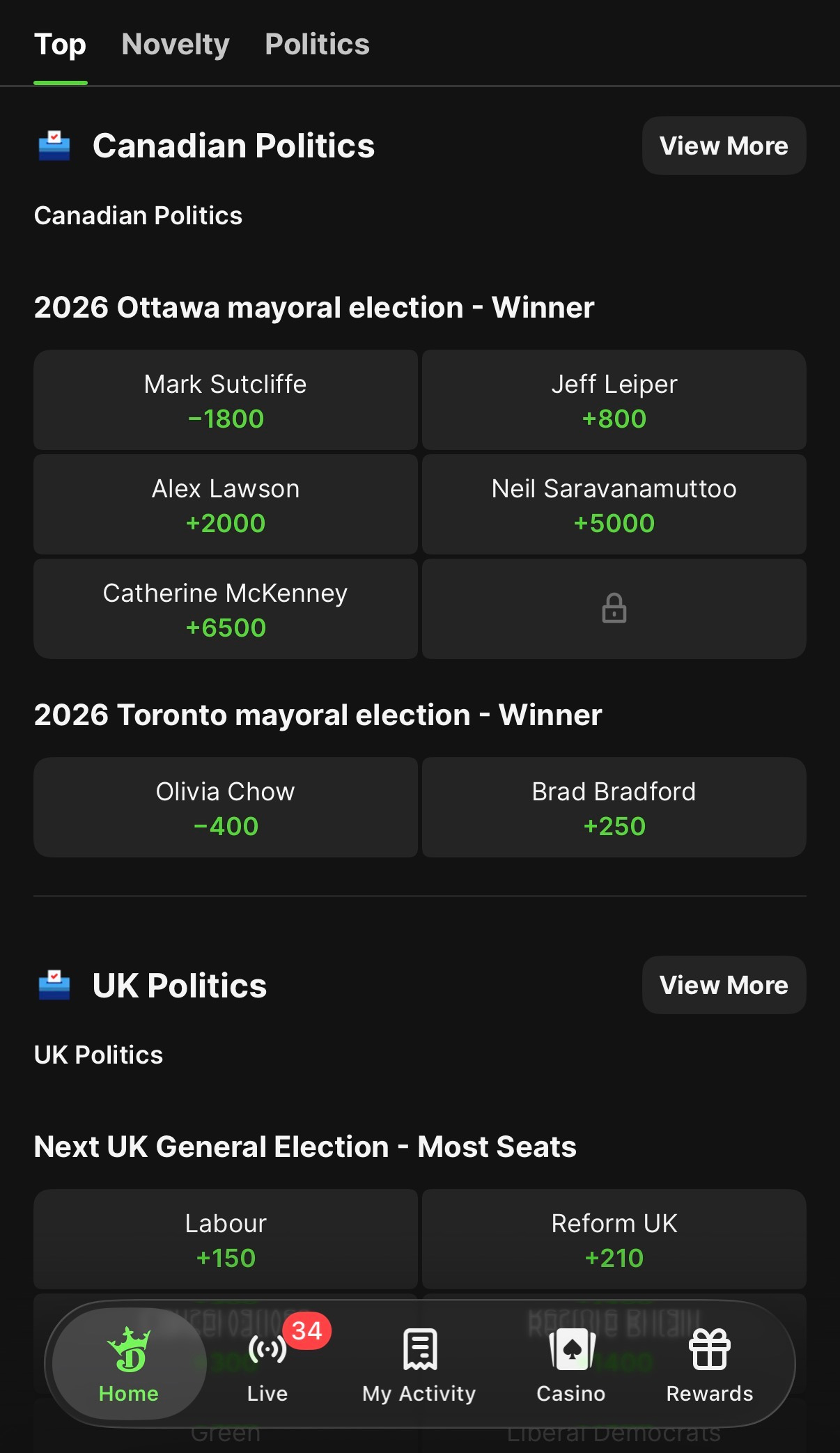
Kudos to McGillivray for correcting her story to focus on the fact that election betting was illegal in Canada via prediction markets – which is true.
The story now opens with the line: “Betting on the outcome of elections on prediction markets isn’t allowed in Canada.”
Yet, on Tuesday, CP24 published a story by Alex Arsenych that begins with the line, “Betting on the outcome of elections is illegal in Canada but there is still more than US$400,000 wagered on who will become the mayor of Toronto on a prediction platform that is currently banned in Ontario.”
The first part of that sentence is completely wrong, of course, but both of these stories point to the bigger problem of the mainstream media getting the entire gambling industry wrong, which makes one question the rest of their reporting on the subject.
In the past, we’ve also found the mainstream media confusing the regulated and unregulated markets. In 2024, a Global News story told the story of a problem gambler who was frustrated with his inability to self-exclude himself from gambling sites – and then showed that person using some unregulated sites, which, of course, do not have to abide by self-exclusion laws because they’re not registered, legal operators.
It all points to the need for the mainstream media to better understand the subject before reporting on it, and for regulators to better educate the media and the public.
Clearly, if the media doesn’t understand how the gambling industry works, the public is even less likely to understand the differences between prediction markets and the regulated / unregulated platforms.
People on the Move
Laura Taylor, ex of Games Global, is appointed fractional Chief Marketing Officer at GameOn.
The Alcohol and Gaming Commission of Ontario promotes Gillian Wong to Senior Advisor, Strategic Planning.
Former Caesars Digital COO and CPO Ken Fuchs joins Nota as an Advisor.
Peter Eugen Clausen departs Stake and his role as Managing Director, Denmark.
Boyd Gaming promotes Rick Goldstein to Senior Vice President of Operations.
Peter Post, ex of IGT, is appointed Vice President - Content Management at MERKUR Group.
Sportradar appoints Brian Josephs as Senior Vice President, Global Sales.
Sean Oellermann is named Head of New Business – iGaming and Sports at CreateFuture.
Tino Liebich is appointed Head of Marketing Operations at Tipwin Limited.
After six years at BetMGM, most recently as Director, Micheal Nagle is leaving the operator. Also making her exit is Senior Regulatory Compliance Analyst Alissa Naylor.
Hannah Whyte is named interim Head of CRM for American sports at DAZN and Parker Sperry is appointed Director of Partner Management.
Todd Nelson has a new title at Aristocrat Gaming as Director of Advance Compliance.
Gaming Performance GmbH appoints Konstantin Nikulin as Director, Strategy & Product Design.
Adam Bourne has a new role at BVGroup as Director of Product, Sports and Gaming.
DAZN appoints Patrick Rose as Director, Strategic Partnerships.
Jason Luong says goodbye to Venetian Resort and walks across the street to become Director of Talent at Hard Rock Las Vegas.
Phil Chadwick exits Stats Perform and his role as Commercial Director – Betting to join Polymarket as Liquidity Lead.
Natalie Cooper joins bet365’s U.S. legal team as Legal Counsel.
Journalist Bobby Allyn departs NPR and joins Bloomberg to lend a hand in its coverage of prediction markets.
Greg Dick is promoted to Deputy Commissioner of the Canadian Football League and Tia Jones has a new role as Senior Director, Digital Marketing & Product.
Former CEBL Commissioner Mike Morreale is named the new President of the CFL Ottawa Redblacks.
Former NorthStar Gaming editorial guru Mike Cormack joins CBC Sports as Senior Producer, Digital.
Classified (Jobs) Information
On the Home Front
The Ontario Ministry of Tourism, Culture and Gaming is looking for a Director of Policy.
Wanted at Bet99: a Senior Acquisition Marketing Lead.
The AGLC requires an Enterprise Portfolio Advisor.
Light & Wonder has an opportunity in Montreal for a Technical Account Manager.
In North York, ON, NSUS Group has an opening for a Community and Social Media Manager, Poker.
Pinnacle is on the lookout for a Financial Reporting Analyst.
Canadian publication Maclean’s is seeking an Editor-in-Chief.
In Toronto, Deloitte is hiring a Senior Editor, AI and Technology, Global Insights.
Wanted by Lacrosse Canada: a Director, Commercial.
The Hamilton Tiger-Cats are in the market for a Senior Manager, Partnership Development & Events.
The Canadian Olympic Committee has a 12-month contract in Toronto for a Manager, Brand and Integrated Marketing.
South of the Border
Wanted at FanDuel: a Counsel Senior Manager, Regulatory Investigations & Enforcement.
In New Jersey, Konami Gaming is seeking a Senior Account Executive.
There’s an opportunity with the American Gaming Association for a Senior Manager, Events.
Hard Rock Digital has need of a Trader – Soccer.
ProphetX has a remote opening for a Product Manager.
The NFL is hiring a Manager, Communications – Consumer Products.
Across the Ponds
DAZN has a hybrid position available for a Head of Product.
EGR Global is on the lookout for a Senior Event Manager.
Betsson Group is searching for a Senior Security Governance Specialist.
In Australia, Aristocrat is hiring a Manager, Internal Communications, APAC.
White Hat Studios is in seek-and-employ mode for a Key Account Manager.
NFL HQ had an opening in London for an Associate Counsel.
Also in London, Google is hiring a Football Partnership Marketing Manager.
For Your Perusing Pleasure
Here at GNC HQ, we’ve heard rumblings over the past few months that there’s interest from Atlantic Canada in going down the regulated gambling road. Well, Adam Huras reported for the Saint John Telegraph-Journal on Monday that the Susan Holt government in New Brunswick is doing the proverbial “exploring options” thing.
At the recent SBC Summit in Lisbon, a panel including Canadian Gaming Association head honcho Paul Burns, legal beagle Ron Segev and PointsBet Canada casino boss Brooke Hilton discussed the possibility of regulated gaming coming to Quebec. Tom Nightingale has the details.
As CTV News’s Adrian Ghobrial reported over the weekend, the Trump Administration’s revamped tax policies are hurting Canada’s horseracing industry.
ICYMI, BetMGM and Connor McDavid have reached a deal for the Edmonton Oilers captain to continue the partnership with the Alberta and Ontario-licensed operator.
Bet99 boss Jared Beber did the Q and A thing with Geoff Zochodne with, of course, a focus on Alberta.
Also from the Covers guy (Zochodne), a read of the excellent sort looking at the future of gambling.
Kinetic Digital is among the newcomers to Alberta’s regulated market.
The aforementioned Nightingale has the deets on River Cree Resort & Casino turning to GiG to lend a hand with the launch of its igaming product.
If you’ve spent the past three-plus months making your way along the Camino de Santiago, Eric Raskin put together a neat-and-tidy summary of Alberta’s regulated market.
As mentioned in our conversation on the latest Gaming News Canada Show presented by Bede Gaming, Front Office Sports journalist Ben Horney was first to report on the For Sale sign being put on SportsGrid.
There was news first thing yesterday of major job cuts at Flutter Entertainment focused on its UK & Ireland operations.
Esports organization Evil Geniuses announced yesterday it will cease operations at the beginning of November.
Wildz Group, which last year closed the digital doors on its Ontario casinos, has been the first operator to confirm getting a licence to thrill in Finland.
The New Jersey Division of Gaming Enforcement recently handed out $100,000 in fines to theScore, DraftKings and Fanatics.
There was reporting a plenty last week, including by ESPN’s David Purdum, that the NBA wants sportsbook to put an end to certain bets and some restrictions on parlays.
In his Cap Space blog, Sam McQuillan examined the relationship between the NBA and sports betting/prediction market operators.
There’s a new article in the Journal of American College Health digging into the data of a study into gambling involving U.S. undergraduate students at a “large U.S. public university”.
The International Tennis Integrity Agency has put the hammer down on a Serbian tennis player who was found to have fixed matches and attempted to fix more.
The U.S. Federal Trade Commission is reported to be looking into allegations of deceptive marketing practices by online sportsbook operators.
The Massachusetts Gaming Commission, reported Robert Linnehan, has sent correspondence to licensed operators on its use of artificial intelligence with their customers.
The CEO of the International Betting Integrity Association argued via the LinkedIn that Brazil’s sports betting ban will set back the efforts to fight match fixing.
Meanwhile, Entain CEO Stella David expects the Brazilian market to reopen.
There’s reporting by Katie Knibbs of Wired that more than $600 million in trades took place on Polymarket AFTER election results were known in Ethiopia and Romania.
Lee Mottershead of The Racing Post delivered a history lesson on the motivation to legalize betting in the UK many, many moons ago.
Gary McFarlane of Gambling Insider did a deep dive into more than 5.3 million trades on Kalshi’s ether futures market.
Eilers and Krejcik Gaming co-founder Adam Krejcik spoke about “the rise of reveal gaming” with Brad Allen on the Zero Latency podcast. Also, here’s the EKG report, for your reading pleasure.
Speaking of EKG, its latest newsletter was a state of the icasino business in the U.S. o A.
Paul Pellizzari, the VP of global social responsibility for Hard Rock International did the op-ed thing for GGB Magazine on the secret to responsible gambling’s “everlasting power”.
The Phildelphia Inquirer reported Monday that the Pennsylvania Gaming Control Board is looking into FanDuel apparently offering its VIP customers a family outing at the Philadelphia Zoo.
NEXT.io scribe Rob Fletcher reports a slowdown in France’s regulated gambling market.
Better Collective has a new subscription-based product for prediction market traders.
Q3 wasn’t very kind to Catena Media.
There’s a study out of Serbia about sport participation and gambling involving adolescents.
Jeff Edelstein tapped the keys on the entrance of trading cards into the casino era.
There was reporting by Sportico’s Dan Bernstein last week that Kalshi has launched new measures to deal with harassment of athletes by bettors.
Speaking of Kalshi a member of its board of directors made the case last week that prediction markets aren’t gambling.
From the Dept. of What the Hell Were They Thinking, Polymarket has withdrawn a market around the alleged rape of a Cornell University student.
Coinbase will no longer offer “new sports related event contracts”, the Michigan Gaming Control Board announced last week.
Finally, Bede Gaming and Sun International have extended their longstanding partnership.
Stay up to date with the news on the Canadian gaming industry by following us on LinkedIn and Twitter.
Please send your news releases and other announcements to steve@gamingnewscanada.ca. Also, if you’re interested in learning about our sponsorship and advertising opportunities in the newsletter and on our podcast, please email Steve McAllister at the aforementioned address.
